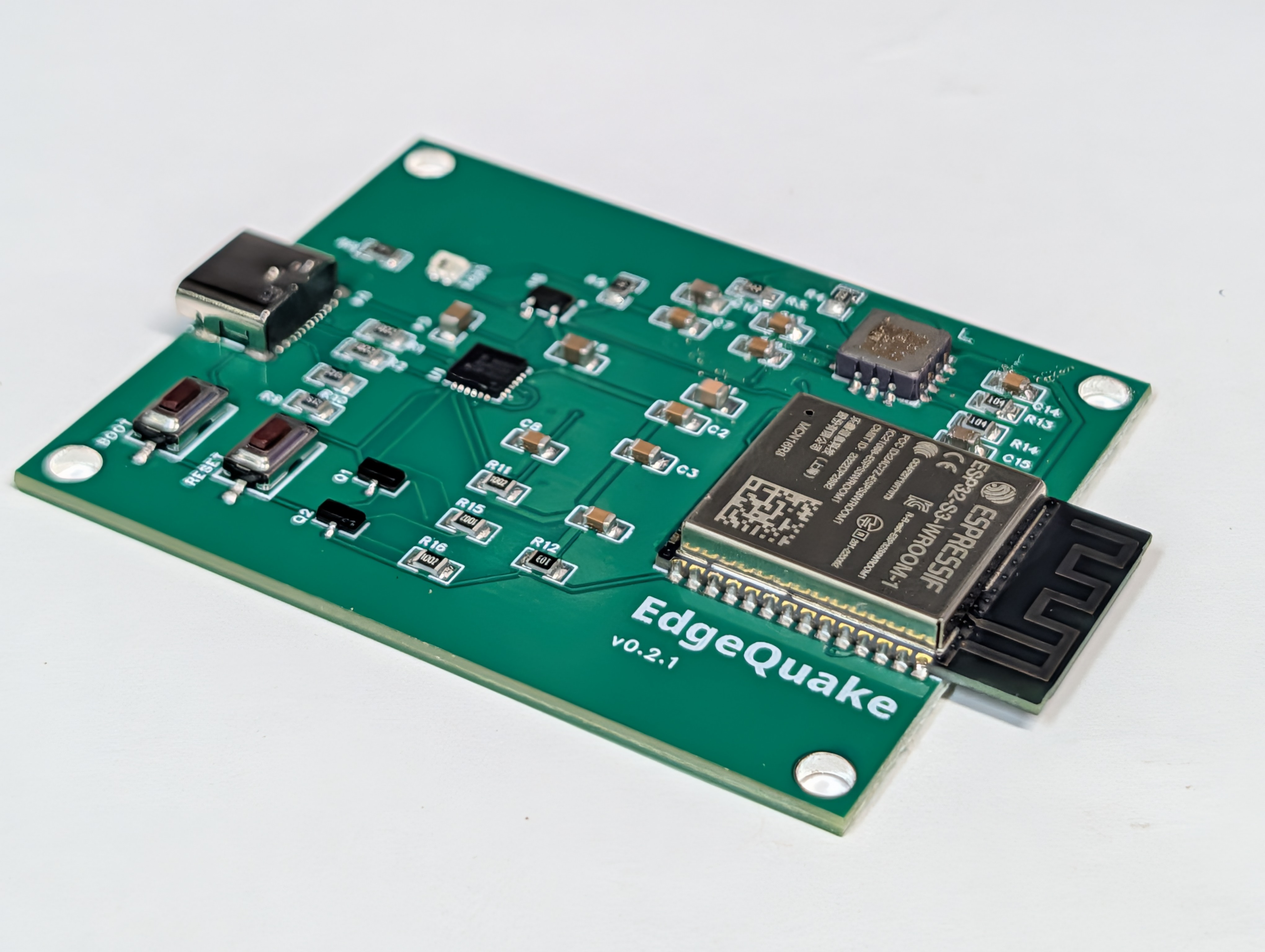
EdgeQuake runs a custom TensorFlow Lite phase-picking model directly on the ESP32-S3 — no cloud round-trip, no hub, no latency tax. Deploy hundreds of nodes across a city and build a real-time early-warning mesh that gets smarter as it grows and scales.
EdgeQuake runs the detection algorithm locally so the most critical seconds aren't lost to network round-trips.
An onboard MEMS accelerometer continuously samples ground acceleration at high frequency, feeding a real-time signal buffer.
The ESP32-S3 runs a lightweight STA/LTA or ML-based phase picker, identifying P-wave and S-wave arrivals without cloud dependency.
Only compact event metadata — arrival time, amplitude, phase classification — is published via MQTT, keeping bandwidth minimal.
Aggregated reports from distributed nodes let backend systems triangulate epicenters and dispatch warnings ahead of destructive shaking.
Unlike repurposed development boards, EdgeQuake is designed from the ground up for always-on seismic monitoring at low cost and low power.
Phase detection runs entirely on-device. Alerts fire even when internet connectivity is intermittent — critical for post-event scenarios.
Built around the ESP32-S3 with integrated Wi-Fi. MQTT over TLS delivers structured event payloads to any broker or cloud endpoint.
Standard USB-C power, accessible boot and reset controls, and exposed GPIO. Built for researchers, not black-box deployments.
Low per-unit cost makes hundred-node urban deployments viable — the density that meaningful early warning demands.
Grillo and Raspberry Shake have proven the market. EdgeQuake advances the edge-native detection model.
| Capability | EdgeQuake | Grillo | Raspberry Shake |
|---|---|---|---|
| On-device phase picking | ✓ | — | — |
| Cloud event metadata streaming | ✓ | — | — |
| Sub-$100 target unit cost | ✓ | ✓ | — |
| Designed for dense urban arrays | ✓ | ✓ | — |
| Standard Wi-Fi (no hub required) | ✓ | Some models | ✓ |
| Geoscience-grade sensor option | Roadmap | — | ✓ |
Any environment that benefits from dense, real-time seismic sensing at affordable scale.
Deploy hundreds of nodes across a city to build redundant P-wave detection meshes, buying critical seconds before S-wave arrival.
Dense low-cost arrays for aftershock monitoring, induced seismicity research, and site response characterization in complex basins.
Hospitals, data centers, and utility control rooms gain automated shake alerts to trigger protective protocols before shaking arrives.
Real-time event detection for carbon capture, wastewater injection, and geothermal operations under regulatory monitoring requirements.
Bring real seismological data into classrooms and undergraduate research programs at a price point that fits departmental budgets.
Grassroots sensor arrays in earthquake-prone regions where official monitoring infrastructure is sparse or underfunded.
EdgeQuake is actively seeking beta partners, researchers, and early adopters. Tell us about your use case and we'll be in touch as hardware availability opens up.
Hardware v0.2.1 prototype complete. Firmware under active development. Targeting beta hardware program in 2025–2026. Priority access for research institutions and municipalities.